

David Schafer began by quoting Heidegger but then stated that he’s not that interested in him. That instantly endeared me to him. The quote was, I think, taken from the essay “Building, Thinking, Dwelling” and described the sky
“‘The sky is the vaulting path of the sun, the course of the changing moon, the wandering glitter of the stars, the year’s seasons and their changes, the light and dusk of day, the gloom and glow of night, the clemency and inclemency of the weather, the drifting clouds and blue depth of the ether”
This passage was sited as an observation that architecture can be a record of seasons and events. That architecture can enhance the natural order celebrating the rhythms of darkness to night winter to spring. The lecture was a series observations. Firstly the nature of a dwelling after dark. How when outward vistas disappear with the daylight the spaces become more introverted. Spaces become defined by the edges of illumination.
Themes that emerged on the topic of home which is this year’s forum focus were those of hope and aspiration, wear and accumulation.
Aspiration
I loved the recognition that the collection of books, the possibility of learning, a library can be perceived as a space of hope. As someone who buys books primarily with the vision of hours of pleasurable future learning ahead this struck a chord with me. David continued to explain that the design of a home is the expression of aspiration, not for a BMW or a competition wit ones neighbours but the aspiration to create a better environment in which to live, an improved space.
Wear
David reflected that when revisiting his favourite case studies such as Maison de Verre by Pierre Chareau and Bernard Bijvoet and Eames House he noticed that he was most attracted to the areas where there was visible wear or patina. Things that are not planned by the architect, occurrences that happen independently of the design process. Also in his own home and studio he valued that which indicates habitation, the wearing of a door handle, the creeping growth of mildew and moss on paving, the scrape of a door swing on a floor. Studio Make are primarily interested in how buildings feel over that of how they look. The user experience.

Baan Sai Ma their home and studio
Accumulation
The moderator of the lectures was a personal friend of the architect and described his studio and home (being one and the same) as housing an eclectic mix of artifacts in a way that is akin to a museum or gallery. David was keen to ensure that the term accumulation was not in reference to the persuit of accruing material wealth but a library of objects which reflect a personal journey.
A specific education resulting in a unique way of working
David and his late wife Im met at undergraduate school in Arizona and then went on to study at Cranbook Academy of Art in Michigan, Im studying ceramics and David, metalwork. The Bangkok studio includes ‘chang’ craftsmen or makers as well as architects who work in collaboration. When a job comes in they review what parts of the project can be built in house and what will be delivered by the contractor; blurring the boundaries between design and construction. it strikes me that designing and crafting a door hinge or piece of furniture for example used to be or certainly traditionally always could be considered the domain of the architect. When has our role become so devolved? I can see that this refreshing approach could be adapted on small scale projects for example taking responsibility for sourcing reclaimed timber to make a vanity and knocking it out in your garage or with the help of a carpenter but think it must be a huge challenge on a larger more corporate project. Patana Gallery at Rangsit University is the studios largest project and in this case, during Q and A, David explained that there involvement had to committed to up front participating in detailed specification based on prototyping and not necessarily making finished items in there office but being armed with the knowledge to tell the contractors that yes they could do what they had drawn in this is how they can do it. The honesty of this approach with its deliberate and clear commitment to taking responsibility for construction is very appealing although potentially might make your usual PI provider a bit nervous.
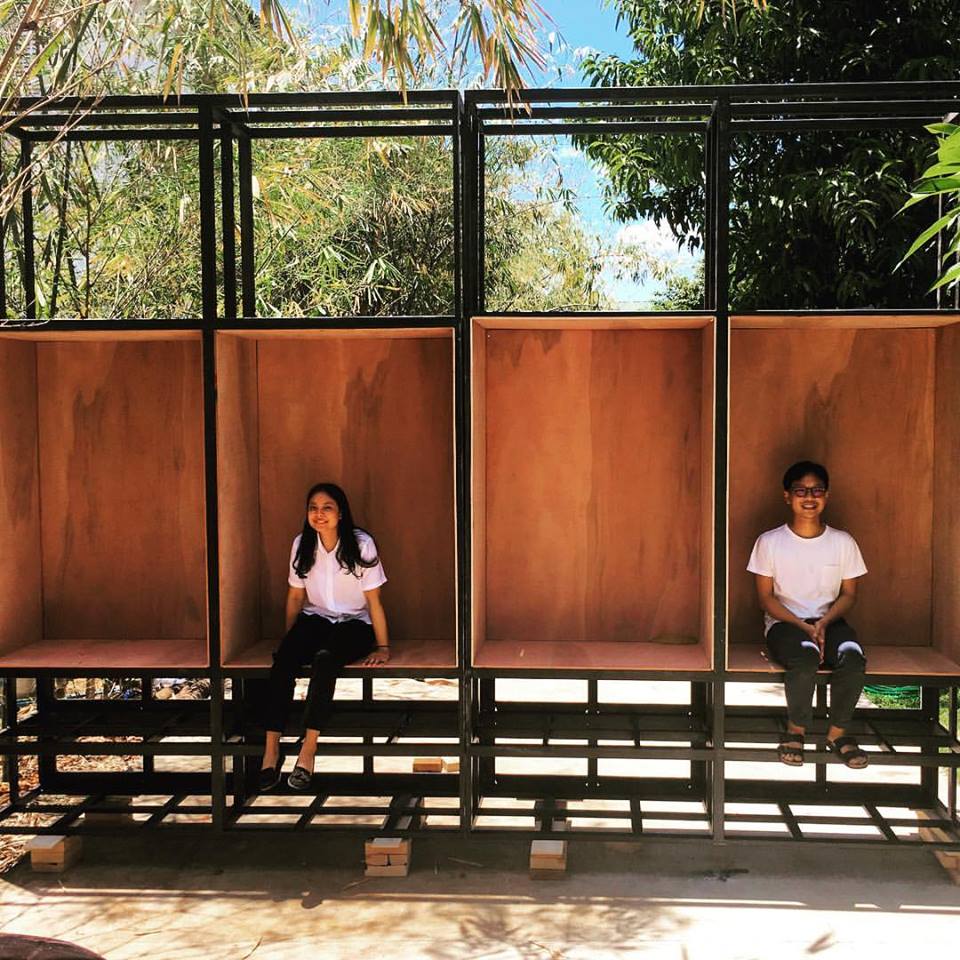
Biggest Cabinet with the smallest Employees of Studiomake. Image from the studio’s Instagram.